
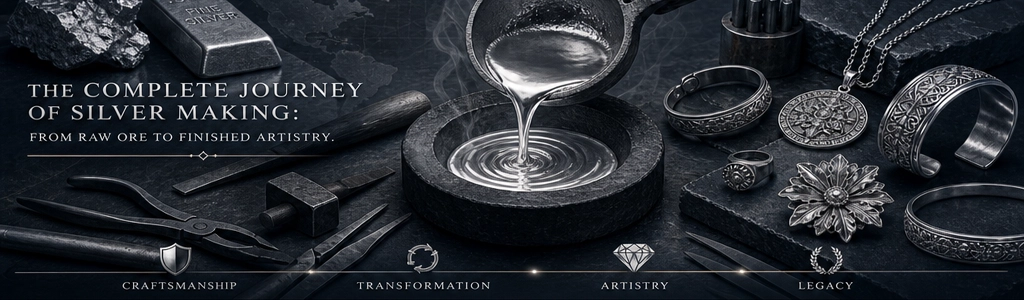
The Complete Journey of Silver Making: From Raw Ore to Finished Artistry
Silver has been treasured for thousands of years, appearing in ancient tombs across Mesopotamia, Egypt, China, Persia, and Greece. Today, the process of transforming raw silver-bearing rock into pure, workable metal blends advanced industrial science with the timeless craft of metalworking. Below is a full, modern overview of how silver is made — from extraction to refined bullion to handcrafted jewelry.
Where Silver Begins: Mining & Extraction
Silver in Nature
- Silver rarely appears in pure, “native” form.
- It is usually found mixed with copper, lead, and zinc ores such as argentite, chlorargyrite (“horn silver”), polybasite, and proustite.
Mining Methods
- Underground mining is common, especially in regions with deep silver veins.
- Ore is blasted, crushed, and transported for processing.
Ore Processing
- Crushing & Grinding – The ore is pulverized to release silver-bearing minerals.
- Flotation – Chemicals help separate silver minerals from waste rock.
- Smelting – The concentrated ore is heated to separate metals.
- Refining – Electrolytic or chemical processes isolate silver from copper, lead, and other metals.
Output
The result is a semi-pure silver material ready for industrial refinement.
Refining Silver to 99.9% Purity
Modern refineries use multi-stage purification to reach 999 fine silver, the standard for bullion and high-end fabrication.
Refining Steps
- Electrolytic Refining – Silver is dissolved and redeposited as ultra-pure crystals.
- Chemical Precipitation – Impurities are removed using controlled reactions.
- Melting & Casting – The purified silver is melted and poured into bars, granules, or sheets.
A recent industrial walkthrough shows how raw ore becomes 99.9% pure silver bars and refined sheets using precision-controlled processes.
Minting & Industrial Forming
Once refined, silver enters the minting or manufacturing stage.
At a Mint
According to Scottsdale Mint, the process requires:
- State-of-the-art machinery
- Engineers, designers, and operators
- Multiple rounds of refining and forming to achieve consistent quality
Minting Steps
- Rolling – Silver is rolled into sheets of precise thickness.
- Blanking – Circular or shaped blanks are punched out.
- Annealing – Blanks are softened through controlled heating.
- Striking – High-tonnage presses stamp designs into the metal.
- Finishing – Polishing, edge treatments, and quality inspection.
This is how coins, rounds, and medallions achieve their crisp relief and mirror-like surfaces.
Artisan Silver Making: From Bullion to Jewelry
This is the part closest to your world — the transformation of pure silver into handcrafted pieces.
Common Techniques
Melting & Casting – Silver is melted in a crucible and poured into molds for pendants, rings, or bars.
Hand Fabrication – Sawing, forging, soldering, and shaping sheet or wire.
Engraving & Texturing – Bas‑relief carving, laser engraving, hammer textures, and oxidized finishes.
Stone Setting – Bezels, prongs, or flush settings for gemstones.
Polishing & Patina High-polish mirror finish, satin finish, or darkened patina for contrast.
Why 999 Fine Silver?
- Extremely bright and reflective
- Hypoallergenic
- Ideal for high-end pendants, devotional pieces, and engraved work
- Soft enough for detailed relief carving, especially with laser depth maps
Environmental & Ethical Considerations
Silver mining has environmental impacts, including:
- Land disruption
- Chemical use
- Water contamination risks
Modern producers increasingly adopt:
- Closed-loop water systems
- Responsible sourcing
- Recycled silver programs
The Future of Silver Making
Advances include:
- Laser-assisted engraving and depth mapping
- Precision CNC milling
- Eco-friendly refining methods
- AI-assisted design for jewelry and minting
- Micro-alloyed silver for improved hardness without losing purity
Silver making is a journey that spans geology, metallurgy, engineering, and artistry. From ore deep underground to the polished 999 silver pendants you craft, each stage reflects thousands of years of innovation and human creativity. Whether produced in a high-tech refinery or shaped by an artisan’s hands, silver remains one of the most enduring and expressive metals in human history.